Slit seeder rental: For a lush, healthy lawn or turf area, proper seeding is the most critical factor. A lawn is key to your home’s appearance, and you should always strive to make it beautiful. When creating a lawn, reseeding an old one, or creating a sports field, the decision on which seeder to use is crucial.
Indeed, the type of machinery used affects seed distribution, germination rate, and the turf’s final quality. As several seeders are created to fulfill specific roles and conditions, understanding which one you should use in your project is essential. They all come with their strengths, from broadcast seeders for quickly covering large areas to precision slice seeders that create an incredibly accurate seed-to-soil ratio.
This guide will take you through the different kinds of seeders you should know about, key considerations when choosing one, and how to get the best results from the machine. Whether you are a professional landscaper, a groundskeeper, or a homeowner with a large lawn, this guide will help you make a suitable choice.
Understanding Different Types of Seeders
Selecting the appropriate seeder starts with understanding the options available. Each type is engineered for specific applications, and knowing their strengths and limitations will help you match the right equipment to your project.
Broadcast Seeders
Broadcast seeders spread seeds across the soil surface. These seeders use a spinning mechanism or a drop system to spread seeds over a wide area, making them among the fastest options for covering large spaces.
Pros:
- Cover large areas quickly and efficiently
- Simple to operate with minimal training required
- Cost-effective option for many projects
- Works well for overseeding existing lawns
- Versatile enough to also distribute fertilizer
Cons:
- Less accurate seed placement compared to other methods
- Seeds remain on the surface, making them vulnerable to wind and birds
- May result in uneven distribution if not operated correctly
- Lower germination rates due to limited seed-to-soil contact
- Can waste seed on hard surfaces or areas where growth isn’t desired
Best use cases: BroadcastspreaderBroadcast seeders are perfect for oversowing vast residential lawns, scattering wildflower seeds over expansive areas, or seeding golf course roughs. When speed is more critical than accuracy, and when you’re dealing with more forgiving grass types that are easy to germinate.
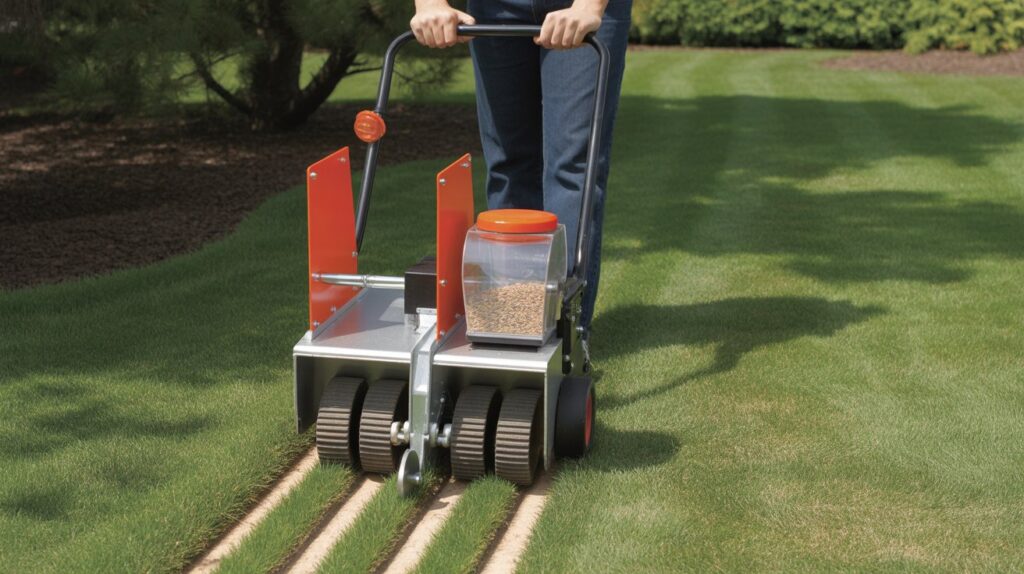
Drop Seeders
Drop seeders are ideal. A spreader drops seeds in a direct line directly under the broadcaster, controlled by a planter. The Droppush spreader drops the seeds in a direct line directly under the broadcaster.
Pros:
- Offer more precise seed placement than broadcast seeders
- Create uniform coverage with minimal overlap or gaps
- Prevent seed waste on sidewalks, driveways, and other unwanted areas
- Work well in confined spaces or near landscaping features
- Allow better control over seed application rates
Cons:
- Slower operation compared to broadcast seeders
- Require multiple passes to cover the same area
- Can create striping if the passes overlap incorrectly
- Not ideal for uneven terrain
- More time-intensive for large projects
Best use cases: Drop seeders are perfect for smaller residential lawns, areas requiring precise application near flower beds or hardscaping, and situations where seed conservation is essential. They work particularly well for homeowners who want professional-looking results without specialized equipment.
Slice Seeders
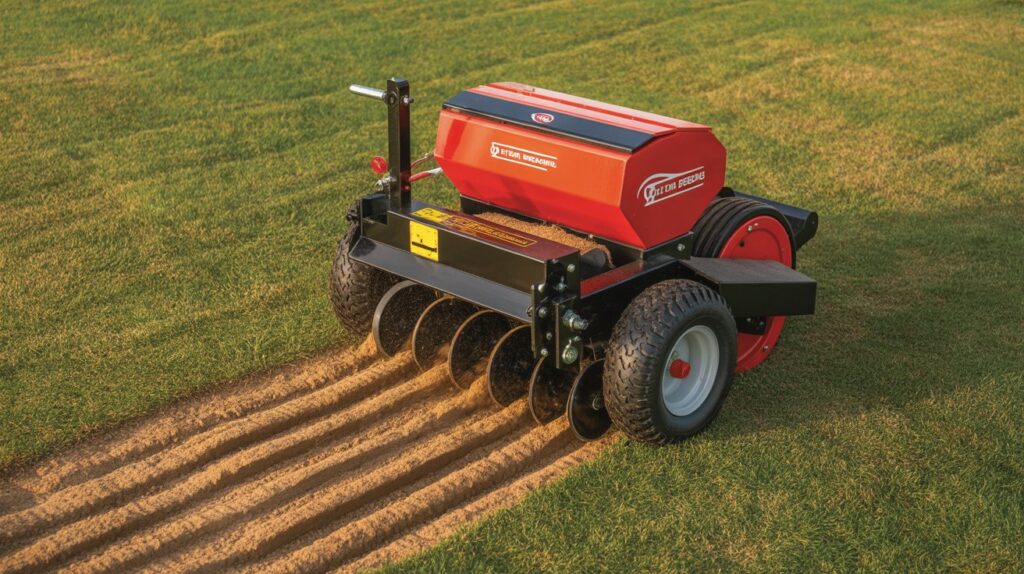
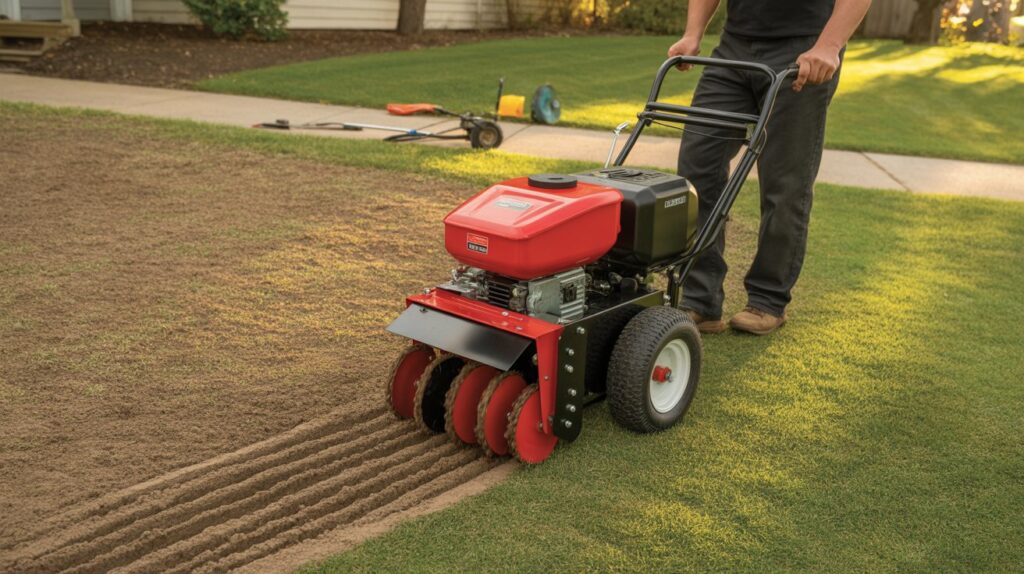
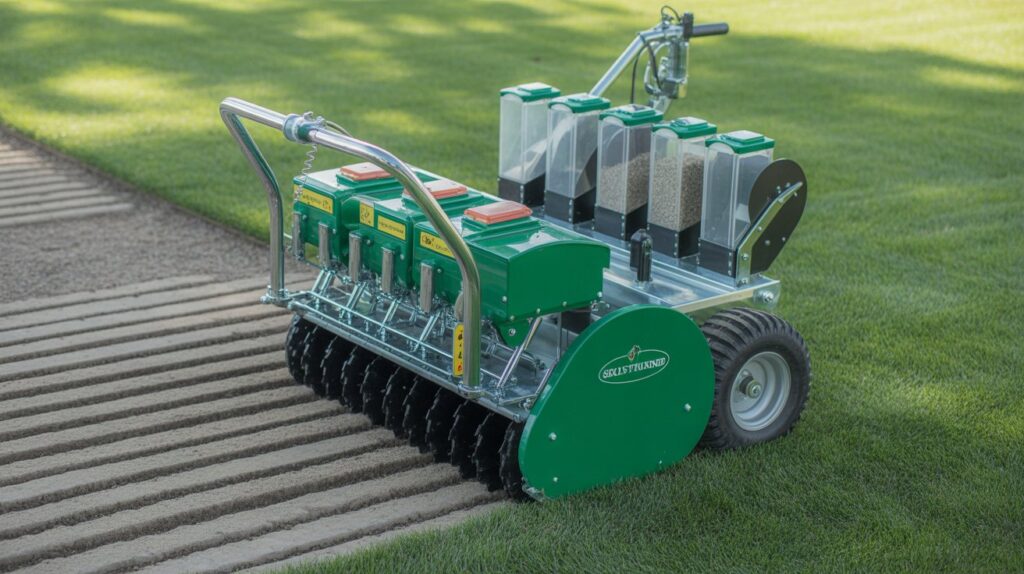
Slice seeders (also called slit seeders) represent the gold standard for turf establishment and renovation. These machines cut narrow grooves into the soil and deposit seeds directly into the slits, creating excellent seed-to-soil contact that dramatically improves germination rates.
MacAllister Rentals offers slice seeder rentals from trusted manufacturers, including Exmark, Lawn Solutions, Ryan, Toro, and Billy Goat. These self-propelled, walk-behind units range from 19 to 30 inches wide, providing options for projects of various sizes.
Pros:
- Provide superior seed-to-soil contact for optimal germination
- Protect seeds from wind, erosion, and birds
- Work effectively on compacted or hard soils
- Allow simultaneous seeding and light aeration
- Deliver more consistent, professional results
- Reduce seed waste significantly
Cons:
- Higher rental or purchase costs compared to other seeders
- It requires more physical effort to operate
- It may be overkill for simple overseeding projects
- Can create visible lines in the lawn temporarily
- Need proper technique to avoid scalping or excessive soil disturbance
Best use cases: Slice seeders are the top choice for establishing new lawns, renovating severely damaged turf, overseeding sports fields and golf courses, and any project where germination success is critical. Professional landscapers and groundskeepers rely on these machines for consistent, high-quality results.
Key Factors to Consider When Choosing a Seeder
As well as these fees, a series of project-specific factors well beyond an understanding of seeder types should influence your choice of equipment. Considering these elements will help you appropriately connect the desired tool to your specific needs.
Area Size
Firstly, the size of your project plays a significant role in determining which seeder to use. Unless you are finding your feet from a lawn or growing grass on a small commercial basis, a simple, inexpensive seeding instrument should suffice. Therefore, for little residential lawns less than 5,000 square feet, invest in a drop seeder or a smaller broadcast seeder type. Meanwhile, for 5,000 to 15,000 square feet, a broadcast seeder or a small slit seeder is ideal for medium residential lawns. You can consider commercial projects, sports fields, and projects larger than 15,000 square feet that require larger-slice seeders or commercial-quality broadcast devices, as well as a slit seeder, the total square footage anticipated, and the project’s speed.
Terrain and Soil Conditions
Your property’s topography and soil characteristics matter tremendously. Level, well-maintained lawns accommodate any seeder type, while properties with slopes, hills, or uneven terrain require equipment with good stability and control. Self-propelled slice seeders handle challenging terrain better than push models.
Soil condition also plays a role. Compacted or clay-heavy soils benefit most from the penetrating ability of slice seeders, which can cut through harsh surfaces. Sandy or loamy soils that are already loose work well with any seeder type. If you’re dealing with severely compacted soil, you might need to rent additional equipment, such as a power dethatcher or aerator, before seeding.
Seed Type and Application Method
Different grass varieties and seed sizes work better with specific seeder types. Fine fescues and ryegrass have smaller seeds that flow effortlessly through most seeders. Kentucky bluegrass and some specialty varieties require equipment with adjustable settings to prevent clogging.
Consider whether you’re establishing a new lawn or overseeding an existing one. The accuracy and seed-to-soil contact that slice seeders offer are essential for new lawn establishment. Slice seeders still produce better results; however, broadcast or drop seeders perform well for over-seeding existing turf to fill in thin spots.
Budget Considerations
Equipment costs vary widely based on type and rental duration. Broadcast and drop seeders represent the most economical options, while slice seeder rentals cost more but deliver better germination rates. When evaluating your budget, consider the actual cost of your project—not just the equipment rental.
A grass seed planter rental that costs twice as much but delivers 50% better germination may actually save money compared to a cheaper option that requires purchasing additional seed for a second application. Factor in seed costs, your time, and the value of achieving your desired results on the first attempt.
MacAllister Rentals offers competitive pricing on all landscaping rental equipment. Call (877) 700-1945 for specific rates and availability in your area.
Best Practices for Successful Seeding
Having the right equipment is only part of the equation. Following proven techniques ensures you get the best possible results from your seeding project.
Proper Soil Preparation
Success starts before you even rent a slice seeder or any other equipment. Begin by removing debris, rocks, and dead vegetation from the area. Test your soil pH—most turfgrass prefers a pH between 6.0 and 7.0. Amend your soil based on test results, adding lime to raise pH or sulfur to lower it.
Address compaction issues by aerating if necessary. Consider renting a sod cutter if you’re replacing an existing lawn rather than overseeding. For the best results, till or loosen the top 2-3 inches of soil before seeding, creating a welcoming environment for new roots.
Optimal Timing
Timing your seeding project correctly can dramatically improve success rates. Cool-season grasses like Kentucky bluegrass, fescues, and perennial ryegrass establish best in early fall when soil temperatures range from 50 to 65°F. Spring seeding also works, but requires more attention to watering and weed control.
Warm-season grasses such as Bermuda, zoysia, and St. Augustine establish best in late spring through early summer when soil temperatures consistently exceed 65°F. Avoid seeding during extreme heat or when drought conditions are likely.
Check with local extension offices for specific timing recommendations in your region, as optimal planting windows vary by climate zone.
Watering and Establishment
Proper watering is critical for germination success. Keep the soil surface consistently moist, but not saturated, for the first 2-3 weeks. This typically means light watering 2-3 times daily, depending on temperature and humidity.
As seeds germinate and seedlings emerge, gradually reduce watering frequency while increasing the amount of water per session. This encourages deeper root development. Once grass reaches mowing height, transition to your regular watering schedule—typically 1-1.5 inches per week through deep, infrequent watering.
Maintenance After Seeding
Avoid foot traffic on newly seeded areas for at least 3-4 weeks or until the grass reaches mowing height. Wait until the grass is 3-4 inches tall before the first mowing, and never remove more than one-third of the blade length in a single cutting.
Apply a starter fertilizer at seeding time, then follow up with additional applications as needed based on your grass type’s requirements. Monitor for weeds, but exercise caution with herbicides—many products can damage or kill new grass seedlings. Spot-treat problem areas or wait until after several mowings before applying broadleaf weed control products.
Frequently Asked Questions
What’s the difference between a slice seeder and a slit seeder?
These terms are interchangeable—both refer to the same type of equipment. Whether you search for “slit seeder rental” or “slice seeder for rent,” you’re looking for machines that cut grooves in the soil and deposit seeds directly into them for optimal germination.
How much does it cost to rent a slit seeder?
Rental costs vary based on location, machine size, and rental duration. Walk-behind slice seeders typically range from $100 to $200 per day. For specific pricing and availability, contact MacAllister Rentals at (877) 700-1945 or visit our location finder to find rental equipment near you.
Can I use a slice seeder on an existing lawn?
Absolutely. Slice seeders work excellently for overseeding existing lawns to improve density and fill in bare spots. The machine’s blades penetrate through existing grass to create ideal conditions for new seed germination without killing established turf.
Do I need any other equipment besides a seeder?
Depending on your soil condition and project scope, you might benefit from additional landscaping rental equipment. Standard complementary rentals include power dethatchers to remove dead material, aerators for compacted soils, and sod cutters for complete lawn replacement projects. MacAllister Rentals can help you determine what equipment package best suits your needs.
Where can I find a slice seeder for rent near me?
MacAllister Rentals operates multiple locations across Indiana and Michigan, offering comprehensive landscaping equipment rentals, including grass slice seeders from top manufacturers. Contact us online or call (877) 700-1945 to find the nearest location and check equipment availability.
How long does it take to seed a lawn with a slice seeder?
Coverage rates depend on machine width and walking speed, but most homeowners can seed 5,000-10,000 square feet in 2-4 hours with a standard 20-inch-wide slice seeder. Professional landscapers working with wider units can achieve even faster coverage.
Making Your Seeding Project a Success
Choosing the right seeder transforms your turf establishment or renovation project from frustrating to fulfilling. While broadcast and drop seeders offer economical solutions for specific applications, slice seeders deliver unmatched results for professionals and homeowners who demand the best germination rates and turf quality.
However, remember that successful seeding depends on more than just the equipment: proper soil preparation, optimal timing, and consistent post-seeding care are also important.
Choose the seeder type that best fits your project’s specific requirements and follow the best practices: the turf of your dreams will become a reality! For optimal results,
MacAllister Rentals: our seasoned professionals will provide the required equipment, expertise, and support. At MacAllister Rentals, you can access a wide range of grass seed planter rentals of various top brands, including Exmark, Lawn Solutions, Ryan, Toro, and Billy Goat.
Are you ready to start? Contact MacAllister Rentals online or call today to discuss your seeding project and make the best rental reservation.