

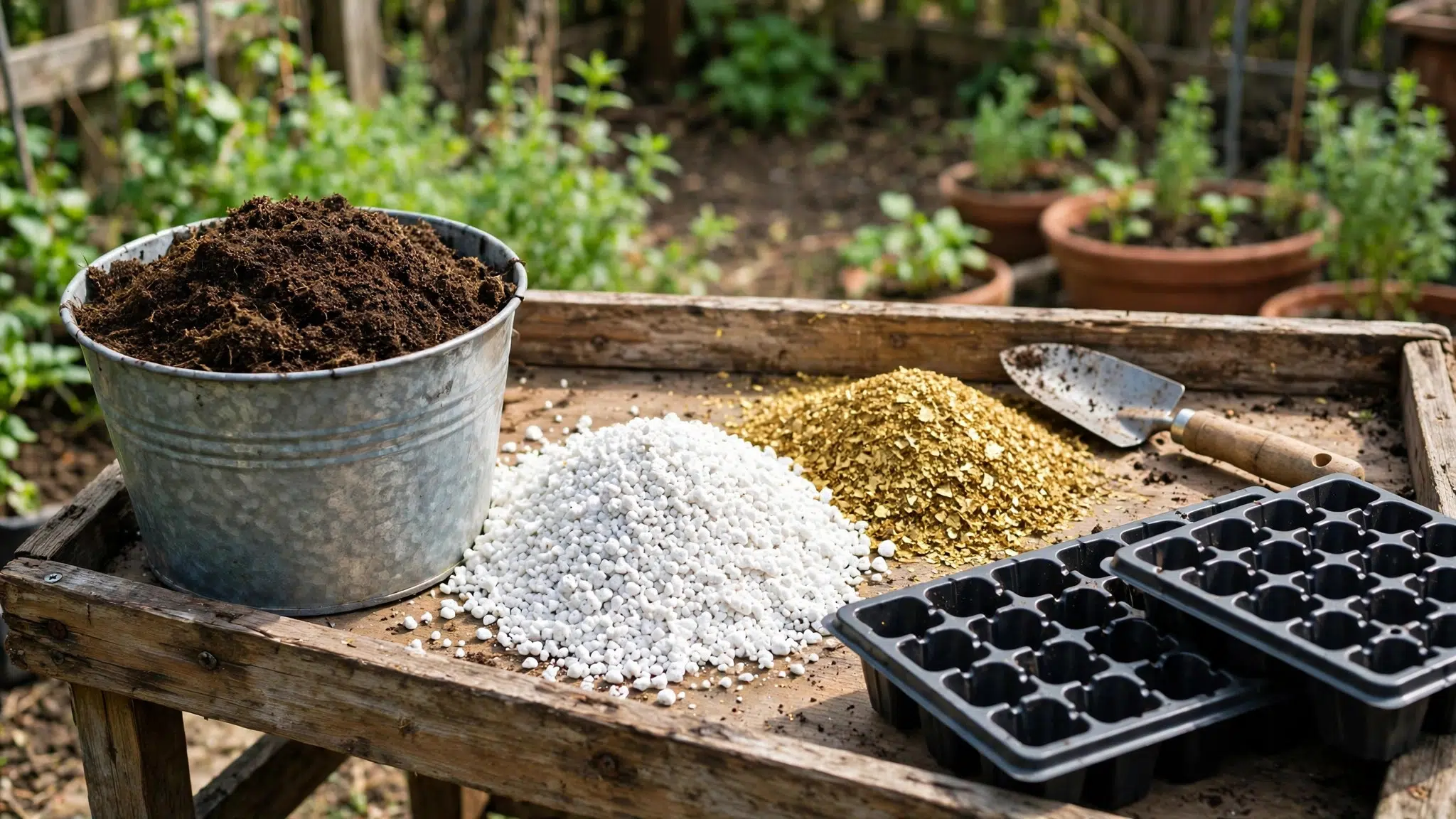
The best soil for starting seeds indoors is a fine, sterile, low-nutrient mix that stays moist without staying soggy — usually a blend of peat moss or coco coir, vermiculite and perlite. Regular garden soil and most potting soils are wrong for seedlings: they are too heavy, hold too much water, and can carry damping-off fungi that kill young plants at the soil line.
What Seed-Starting Mix Must Do
A seed does not need fertilizer to germinate — it carries its own food supply in the seed. What it needs from the mix is physical: steady moisture, air around the emerging root, and a clean environment. A good seed-starting mix therefore does four things:
- Holds moisture evenly. The seed coat must stay damp until the root emerges. A mix that dries out in hours fails this test.
- Drains freely. Standing water rots seeds and invites damping-off fungi. Excess water must drain away within minutes.
- Stays light and fine. Tiny seeds cannot push through coarse bark or big perlite chunks. The texture should be almost like coffee grounds.
- Starts clean. Sterile, soilless ingredients mean no weed seeds and far fewer disease organisms than garden soil.
The University of Illinois Extension and the University of Minnesota Extension both recommend a sterile soilless mix for starting seeds indoors, and warn specifically against using garden soil, which compacts in containers and can harbor soil-borne disease.
If you are planning your whole indoor setup, our complete guide to starting seeds indoors covers containers, light and timing alongside soil.
Store-Bought vs Homemade
| Option | Pros | Cons | Best for |
|---|---|---|---|
| Bagged seed-starting mix | Sterile, consistent, ready to use | Costs more per tray | Beginners, small batches |
| Homemade mix (recipes below) | Cheaper in bulk, full control | Needs ingredients + mixing time | Regular seed starters |
| Regular potting soil | Easy to find | Often too coarse and too rich; can hold too much water | Not recommended for seeds |
| Garden soil | Free | Compacts, carries disease, weed seeds | Never use indoors |
Bagged mixes from reputable brands are fine and are the simplest choice for a first season. If you start seeds every year, a homemade mix costs a fraction of the price per tray.
3 Proven Seed-Starting Mix Recipes
All three recipes make roughly one large bucket of mix — enough for several trays. Moisten the mix before filling cells: add water gradually until a squeezed handful holds together without dripping.
Recipe 1 — Classic peat mix (simplest)
- 4 parts peat moss or coco coir
- 1 part perlite
- 1 part vermiculite
Sift out any large chunks. This is the closest to a good bagged mix and works for nearly every vegetable and flower seed.
Recipe 2 — Coir mix (peat-free)
- 4 parts coco coir
- 1 part perlite
- 1 part vermiculite
- A pinch of garden lime per gallon (coir is slightly acidic; lime balances pH)
A good choice if you prefer a renewable alternative to peat moss. Coir holds water well, so watch drainage and water a little less often.
Recipe 3 — Compost-based mix (for bigger seedlings)
- 2 parts screened, finished compost
- 2 parts coco coir or peat moss
- 1 part perlite
- 1 part vermiculite
The compost adds gentle nutrition for seedlings that stay indoors longer, such as tomatoes and peppers. Use only fully finished, sweet-smelling compost, and consider pasteurizing it (30 minutes at 180°F in the oven) if you have had damping-off problems before.
Our detailed guide with step-by-step mixing and storage, DIY seed starting mix recipe, gives three more blends with exact measurements and costs.
Ingredients Explained
| Ingredient | What it does | Notes |
|---|---|---|
| Peat moss / coco coir | Holds moisture, gives structure | The base of nearly every mix; coir is the renewable alternative |
| Perlite | Drainage and air pockets | White volcanic rock; lightweight, does not break down |
| Vermiculite | Holds water and nutrients | Gold-brown flakes; use fine grade for seeds |
| Compost | Gentle nutrition, biology | Only fully finished compost; can introduce disease if raw |
| Sand | Drainage | Use coarse horticultural sand, never fine beach sand (compacts) |
Do not add fertilizer to a seed-starting mix. Seedlings need no feeding until they have their first true leaves, and fertilizer salts can burn tender roots and encourage the soft, leggy growth that damping off loves. Start feeding at half strength only after true leaves appear.
Mistakes That Kill Seedlings
- Using garden soil. It compacts, drains badly and carries damping-off fungi. The most common beginner mistake.
- Using a mix that is too coarse. Bark chips and large perlite block tiny roots and dry out the surface.
- Keeping the mix soggy. Constant wetness is the main cause of damping off. Water from below, and let the surface dry slightly between waterings.
- Skipping the pre-moisten step. Dry mix repels water and leaves dry pockets where seeds never germinate. Always moisten before sowing.
- Reusing old mix without sterilizing. Used mix can carry disease. Either use fresh mix or pasteurize reused mix before sowing again.
If seedlings are collapsing at the soil line, the cause is almost always damping off, and soil choice is part of the fix. Our guide on damping off seedlings covers prevention and treatment in full.
Frequently Asked Questions
Can I use regular potting soil to start seeds?
You can, but it is not ideal. Most potting soils are coarser and richer than seedlings need, hold too much water, and can contain bark that blocks tiny roots. A dedicated seed-starting mix — bagged or homemade — gives more even germination and fewer losses to damping off.
Is peat moss or coco coir better for seed starting?
Both work well. Peat moss is the traditional choice and slightly acidic, which most seeds like. Coco coir is renewable, holds water well and has a near-neutral pH. Choose coir if you prefer peat-free; add a pinch of lime per gallon to balance its pH.
Do seeds need fertilizer in the starting mix?
No. Seeds contain their own food supply and germinate best in a low-nutrient mix. Start feeding at half strength only after the first true leaves appear — usually 1–2 weeks after germination.
Can I reuse seed-starting mix?
Yes, if you pasteurize it first (30 minutes at 180°F) and remove old roots. Fresh mix is safer and cheap enough that most gardeners use new mix each season for seeds, and reuse old mix for potting on larger plants.
How wet should seed-starting mix be?
Like a wrung-out sponge: damp all the way through, holding together when squeezed, but no water dripping out. Water from below so the surface stays drier, which discourages damping off.


