

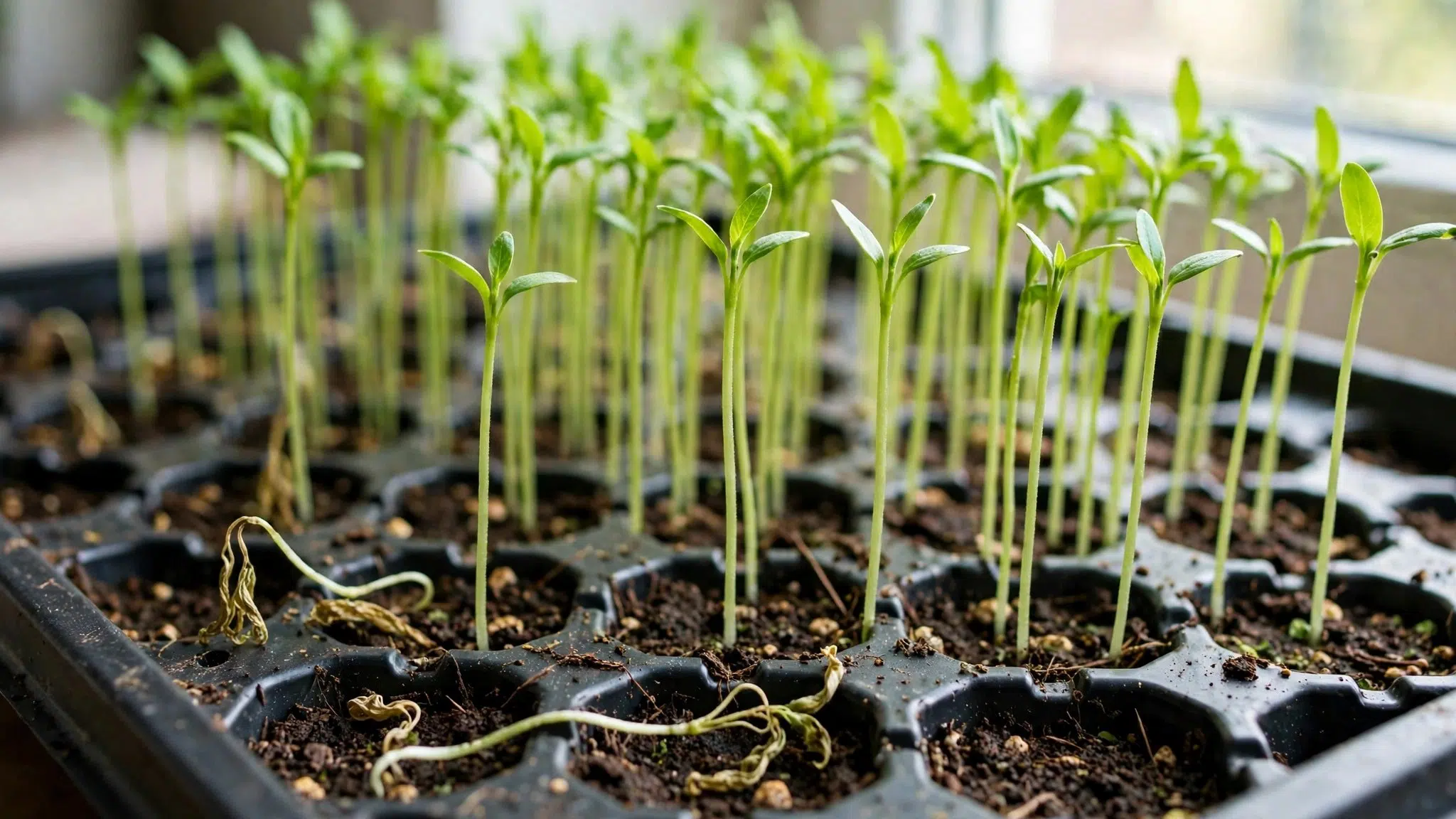
Damping off seedlings is a fungal disease that makes seedling stems thin, pinch in and collapse at the soil line. It strikes in cool, wet, still air — usually in the first two weeks after sprouting. There is no cure for an infected seedling, so prevention is everything: sterile mix, clean containers, good air flow, and watering only when the surface dries.
What damping off looks like
Damping off has two forms, both caused by soil fungi such as Pythium, Rhizoctonia and Fusarium. Pre-emergence damping off kills the seed before it breaks the surface — the tray just looks empty. Post-emergence damping off is the one most gardeners see: a healthy-looking seedling suddenly wilts, its stem narrows to a thread at the soil line, and it topples over. The stem often looks water-soaked or brown where it meets the soil. Once a seedling has collapsed, it will not recover.
| Symptom | Likely cause |
|---|---|
| Seedling falls over, stem thin and pinched at soil line | Damping off (fungal) |
| Seedling falls over but stem looks normal and firm | Too little light — leggy seedling topples under its own weight |
| Whole tray wilts, soil smells sour | Overwatering / no drainage |
| Seeds never sprout at all | Soil too cold, old seed, or pre-emergence damping off |
| White mould on the soil surface | Excess moisture and still air — a warning sign, not yet damping off |
Why damping off happens
The fungi that cause damping off are present in most garden soil and on unwashed containers. They only attack when conditions favour them:
- Wet soil that never dries out — the single biggest trigger. Constantly soggy mix is perfect for fungi.
- Poor air circulation — still, humid air around crowded seedlings.
- Cool soil and cool rooms — slow growth gives fungi more time to attack.
- Overcrowding — seedlings packed together stay damp and spread infection fast.
- Dirty containers or reused mix — fungi survive on old trays and in used soil.
- Sowing too deep — seeds struggle longer underground, where fungi live.
How to prevent damping off (the checklist that works)
- Start with sterile seed-starting mix, not garden soil. A fresh, light mix is the first line of defence — see our DIY seed starting mix recipe.
- Clean every container before sowing: wash with hot soapy water, then rinse with a 1:9 household bleach-to-water solution and let it dry.
- Sow thinly and thin early. Crowded seedlings stay wet and spread disease. Thin to one seedling per cell after the first true leaves.
- Water from below and only when the surface starts to dry. Never leave trays sitting in water — empty the drip tray after 15–20 minutes.
- Give seedlings moving air. A small fan on low, a few feet away, running a few hours a day strengthens stems and dries the surface. This is the most under-used prevention step.
- Give 14–16 hours of bright light, 2–4 inches above the tops. Strong light grows stocky stems that resist infection. See starting seeds indoors for the full setup.
- Keep soil warm (65–75°F). Cold, slow-growing seedlings are the most vulnerable.
- Remove the humidity dome as soon as seeds sprout. A dome left on traps moisture and still air.
- Use clean water and clean hands — and never reuse mix from a tray that had damping off.
What to do when damping off starts
There is no spray or home remedy that reliably saves an infected seedling — do not waste the tray trying.
- Remove affected seedlings immediately, with the soil around them, and throw them in the bin (not the compost).
- Stop watering until the surface dries, and increase air flow right away.
- Thin the remaining seedlings so air moves between them.
- Move healthy seedlings to fresh, sterile mix if the outbreak is spreading — handle them by the leaves, never the stem.
- Start again if most of the tray is down. Clean the tray properly first, then re-sow. Most seeds germinate fast enough that a restart costs only a week — far less than nursing a sick tray. If your seeds never sprouted at all, first check whether the seed itself was the problem with the 10-seed viability test.
Damping off vs leggy seedlings — don’t confuse them
Both make seedlings fall over, but the fix is different. Damping off pinches the stem at the soil line — the stem looks thin, dark or water-soaked there. A leggy seedling has a long, pale, weak stem that bends or flops, but the base looks normal. Leggy seedlings need more light; damping off needs drier air and cleaner conditions. If you are unsure, check the stem at the soil line — that is where damping off always shows.
Frequently Asked Questions
What is damping off in seedlings?
Damping off is a fungal disease (Pythium, Rhizoctonia, Fusarium) that rots the stem at the soil line, so seedlings collapse and die. It thrives in wet, cool, still conditions in the first two weeks after sprouting.
Can damping off be cured?
No — an infected seedling cannot be saved. Remove it immediately, dry the soil surface, improve air flow, and protect the healthy seedlings. Prevention (sterile mix, clean trays, bottom watering, moving air) is the only reliable control.
How do I prevent damping off?
Use fresh sterile seed-starting mix, clean containers, sow thinly, water from below only when the surface dries, remove humidity domes after sprouting, and run a small fan for air circulation.
Does cinnamon stop damping off?
Cinnamon is a popular home remedy, but university extension guidance does not list it as a reliable control. Clean mix, dry surfaces and air flow are the measures with real evidence behind them — rely on those first.
Can I reuse soil after damping off?
No — do not reuse mix from an affected tray. Throw it away, clean the container with hot soapy water and a diluted bleach rinse, and start with fresh sterile mix.


