

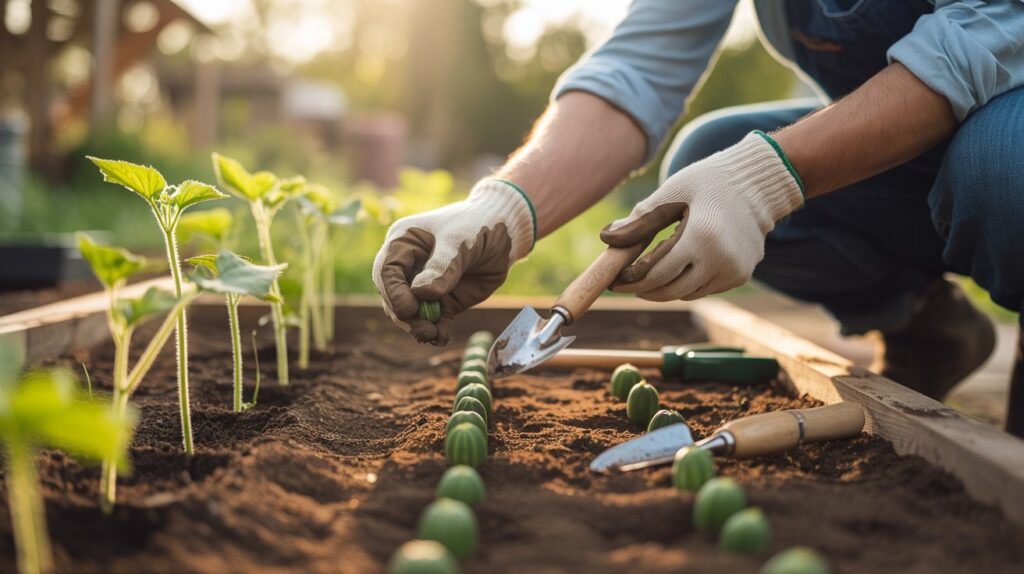
How to save cucumber seeds: let one fruit ripen far past eating stage until it turns yellow, swollen and soft, then scoop out the seeds, ferment them in water for 1–3 days to remove the gel coating, rinse, dry for 2–3 weeks, and store cool and dry. Done right, home-saved cucumber seeds stay viable for 5 years or more.
The Catch First: Cross-Pollination
Cucumbers cross-pollinate easily. Bees carry pollen between any two cucumber varieties flowering at the same time, and the seeds from a crossed fruit will not grow true to either parent — you may get bitter, oddly shaped or low-yielding plants next year.
The rules, from Seed Savers Exchange and university extension guidance, are:
- Grow only one cucumber variety if you want to save seed, or
- Isolate varieties by at least 1/2 mile (800 m) in open gardens, or
- Hand-pollinate: bag female flowers before they open, pollinate by hand with a male flower from the same variety, and re-bag the flower until the fruit sets. Mark the hand-pollinated fruit with a ribbon.
Hybrid (F1) varieties will not grow true from saved seed even without crossing, because their offspring split back into the parent lines. Save seed only from open-pollinated or heirloom varieties, and check the packet: it will say “open-pollinated” or “heirloom” if it qualifies.
If your garden grew only one open-pollinated variety this year, you can skip hand-pollination entirely — that is the simplest setup for a first attempt.
Step by Step: Saving Cucumber Seeds
1. Let a fruit over-ripen
Pick one healthy fruit from your best plant and leave it on the vine long past eating stage — 3–4 weeks after it would normally be picked. It will swell, turn yellow (sometimes orange), and feel soft. This is the sign the seeds inside are fully mature. Seeds from a green, eating-stage cucumber are immature and will not germinate well.
2. Scoop out the seeds
Cut the overripe cucumber lengthwise and scoop the seeds and pulp into a glass jar. Add a little water — about as much water as pulp — and stir.
3. Ferment for 1–3 days
Leave the jar at room temperature, stirring once a day. The mixture will bubble slightly and may smell sour: this is fermentation breaking down the gel coating around each seed, the same process used for tomatoes. Good seeds sink to the bottom; bad seeds and pulp float. After 1–3 days, when the gel is gone and the water looks cloudy, the seeds are ready.
Do not ferment longer than 3 days — seeds can begin to sprout in the jar.
4. Rinse and dry
Pour off the floating pulp, then rinse the sunken seeds in a fine strainer under running water, rubbing gently to remove any remaining gel. Spread them in a single layer on a ceramic plate, a screen or a paper towel (not newspaper — seeds stick to it). Dry in a well-ventilated spot out of direct sun for 2–3 weeks, stirring occasionally, until a seed snaps cleanly when bent instead of bending.
5. Store cool, dry and dark
Put fully dry seeds in a labelled paper envelope inside an airtight jar, with the variety name and the year. Store in a cool, dry, dark place — a fridge is ideal. Our guide on how to store seeds covers containers, moisture control and the best storage spots in detail.
The process mirrors tomato seed saving closely: if you have done tomatoes before, cucumbers will feel familiar. Our guide on how to save tomato seeds explains the fermentation method in full.
How Long Do Saved Cucumber Seeds Last?
| Storage | Expected viability |
|---|---|
| Room temperature, dry jar | 3–5 years |
| Fridge, airtight container | 5–10 years |
| Freezer, fully dry seeds | 10+ years |
Viability drops with heat and moisture, not with age alone. Before sowing an old batch, run the 10-seed viability test — it takes a week and tells you whether to sow thickly or buy fresh seed.
Common Mistakes
- Saving seed from a green cucumber. Immature seeds germinate poorly or not at all. Wait for yellow and soft.
- Skipping fermentation. The gel coating contains germination inhibitors. Unfermented seeds sprout slowly and unevenly.
- Saving seed from a hybrid. F1 hybrids do not grow true. Check the packet for “open-pollinated” or “heirloom”.
- Growing two varieties side by side. Bees will cross them. Grow one variety, isolate, or hand-pollinate.
- Storing seeds before they are fully dry. Damp seeds mould in storage. The snap test is the check: a dry seed snaps, a damp seed bends.
- Forgetting the label. Unlabelled envelopes are useless by spring. Write variety + year on every packet.
Frequently Asked Questions
Can you save seeds from a store-bought cucumber?
Usually not worth it. Store cucumbers are often hybrids picked immature, and the variety is unknown — saved seeds may grow bitter or unlike the parent. Save seed from a known open-pollinated variety you grew yourself.
How do I know if my cucumber is a hybrid?
Check the seed packet or plant tag: hybrids are marked “F1” or “hybrid”. Open-pollinated and heirloom varieties are marked as such, and they are the ones to save seed from.
Do cucumber seeds need fermenting?
Yes, for best results. The 1–3 day ferment removes the gel coating that inhibits germination, and it also helps separate good seeds (which sink) from bad ones (which float).
How many seeds should I save?
Save at least 20–30 seeds from one fruit — a single overripe cucumber usually holds 50–100 — so you have spares for a germination test and for sharing.
Will saved cucumber seeds grow the same cucumbers?
Yes, if the variety is open-pollinated and it was not crossed with another variety. Grow one variety, isolate, or hand-pollinate to keep the seed true.


